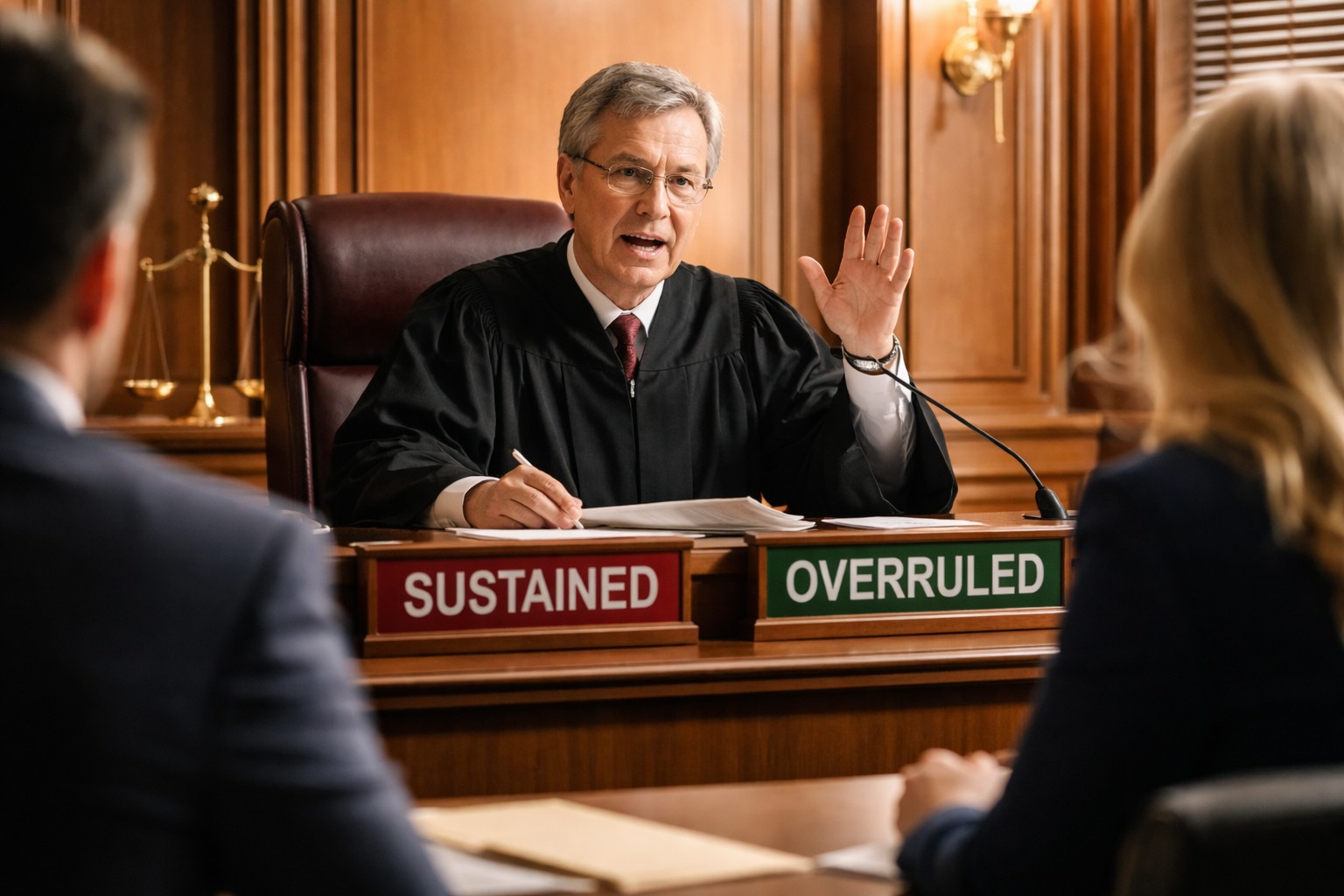
A trial can feel like normal talk until one person interrupts. A lawyer says “Objection,” and the room pauses. The judge responds right away. The judge may say sustained or overruled. People search overrule vs sustain because these rulings decide what the jury can use. That quick ruling decides what the witness can say next and what the jury can use later. These words do not exist for drama. They enforce the rules that keep evidence fair and the record clean. Anyone who wants to understand courtroom objections should start with these two rulings.
The split second that decides what stays on the record
A trial runs on rules. Attorneys test those rules every time they ask a question, present a document, or push a witness into a corner. When one side thinks the other crossed a line, they object. That single word stops the flow and forces a ruling.
The judge does not “pick a side” in a personal sense. The judge decides whether the law allows what just happened. That decision becomes either sustained or overruled.
This is why objections matter so much. Trials are not just about truth. Trials are about what can be proven under rules that courts accept. A judge’s ruling decides what proof the jury can legally use.
The fastest way to tell them apart
People often ask “What does sustained mean” or “What does overruled mean.” That helps, but it is not enough. The easiest way to remember the difference is to picture what happens next.
- If the judge says sustained, the lawyer who asked the question usually has to stop and change course.
- If the judge says overruled, the lawyer who asked the question usually gets to continue.
That is the heartbeat of it. Everything else is detail.
Sustained means the judge blocks the move
A sustained objection means the judge agrees that the question, answer, or evidence breaks a rule. The court shuts that door. The disputed material does not become part of the trial record in the normal way.
A sustained ruling usually stops the question right away. The witness stays quiet. The lawyer must rephrase or move on. Judges may also strike the last statement and tell jurors to ignore it, even if they already heard it.
That last part sounds unrealistic to non-lawyers. People wonder how jurors can “unhear” something. Courts still require the instruction because it protects fairness and preserves the record if an appeal happens later.
Judges lean on established rules, including the Federal Rules of Evidence in federal courts and similar state evidence rules in state courts. Hearsay is a common reason. Courts often exclude hearsay unless an exception applies.
A real example that fits the typical pattern
In State v. Jackson (Ohio Court of Appeals, 2017), defense counsel objected to testimony that referred to statements made outside the courtroom. The judge treated that testimony as hearsay and sustained the objection. The jury did not receive that disputed content as usable evidence, and the case moved forward on other proof.
Overruled means the judge lets it in
An overruled objection means the judge does not accept the challenge. The court allows the question or the evidence. The witness can answer, and the jury can consider what comes next unless the judge changes course later.
After an overruled objection, the trial usually keeps moving. The witness responds, the lawyer continues the same line of questions, and any document or record at issue may become part of the official evidence. The lawyer who objected has to adjust fast and decide whether to object again on a different legal ground or move to the next point.
An overruled objection also does not mean the lawyer made a mistake. Lawyers object to protect their client and preserve the record. Some objections also help the court stay strict about rules, such as proof foundation, even if the judge allows the evidence in the end.
In United States v. Brown (U.S. District Court, Southern District of New York, 2015), defense attorneys objected during questioning about financial records. The judge overruled the objection after finding the evidence relevant and properly authenticated. Those records later played an important role in the prosecution’s case.
What changes in the courtroom after each ruling
It helps to see sustain vs overrule as an evidence filter. One ruling blocks. One ruling allows.
Here is a simple comparison that matches how courtrooms operate:
| Point that matters | Sustain | Overrule |
|---|---|---|
| Judge’s response to the objection | Judge agrees | Judge disagrees |
| What happens to the evidence or question | It gets blocked or removed | It stays and moves forward |
| What the jury can consider | Not in the normal record | It can be considered |
| Who gets the immediate advantage | The objecting side | The side offering the evidence |
A single ruling can tilt a trial. A sustained hearsay objection may remove a damaging “story” the jury would remember. An overruled foundation objection may open the door to records that support a timeline, motive, or financial theory.
Why lawyers still object even when they know the judge may disagree
New readers often think objections are only used when the lawyer is confident. That is not how real trials work.
Lawyers object even when they suspect the judge will overrule. They do it to protect the record. If the issue matters later, an appeal might depend on whether the lawyer objected at the right moment.
Trial lawyers also object to test boundaries. Judges sometimes give quick rulings early, then tighten standards later when context changes. Objections help shape those boundaries in real time.
What judges listen for before they sustain or overrule
Judges do not have time to hear a long speech after every objection. Good lawyers state the rule quickly. Judges focus on whether that rule applies right now.
The most common decision points look like this.
Relevance decides many objections
Evidence must connect to a fact that matters in the case. If it does not, the judge may sustain an objection as irrelevant. Courts also limit evidence that wastes time or distracts the jury, even if the evidence has a slight connection.
In a car crash trial, a lawyer may ask about the driver’s old speeding tickets. The other side may object as unfair or irrelevant. A judge may sustain if it distracts from the crash facts, or overrule if it relates to pattern or credibility.
Hearsay fights happen every day
Hearsay means an out-of-court statement offered to prove the truth of what it claims. Courts usually exclude it unless an exception applies. Many objections succeed on hearsay because lawyers try to sneak in what someone else said without bringing that person to testify.
Leading questions create predictable clashes
Leading questions suggest the answer. Courts usually restrict leading questions during direct examination. Cross-examination often allows them because the witness is typically aligned with the other side. Judges decide quickly based on which stage of questioning is happening.
Speculation is a quiet trial killer
Witnesses must testify from personal knowledge. Judges sustain objections when a witness guesses, assumes facts, or offers conclusions without support. This comes up a lot with “You must have seen…” or “He probably meant…” type answers.
Foundation matters more than people realize
Many pieces of evidence fail because a lawyer did not lay the groundwork. A judge may sustain an objection if a document lacks authentication or a witness cannot confirm what the item is and where it came from.
These rules do not exist to create obstacles. They exist to prevent unfair proof and to keep trials focused on reliable information.
Jury trials change the pressure on these rulings
In a bench trial, the judge hears everything and decides the facts. Evidence rulings still matter, but the judge can separate noise from proof without worrying about confusing jurors.
Jury trials create a different reality. Jurors can only work with what the court permits them to consider. A judge who sustains an objection may instruct jurors to disregard a statement. Courts treat that instruction seriously because it preserves fairness and reduces the chance of a mistrial.
Overruled objections also affect juror perception. Some jurors read objections as signs that a lawyer wants to hide something. Others see objections as routine. Judges avoid explaining too much in front of jurors because explanations can accidentally highlight the disputed content.
Objections as a strategy tool, not a tantrum
Trial lawyers do not object only to “win” a moment. Objections serve multiple purposes.
A sustained objection can do more than block a question. It can force the other lawyer to change the rhythm. It can weaken a witness’s confidence. It can protect a clean narrative by cutting out side issues that would confuse the jury.
An overruled objection can also be useful. It tells the objecting lawyer where the judge’s line sits. That knowledge helps the lawyer adjust witness prep, change questioning style, and decide whether a topic is worth pushing later.
Skilled lawyers treat objection rulings like live feedback. They do not take them personally. They use them.
Courtroom objections look calmer than TV makes them seem
TV court scenes often treat objections like a big showdown. Real court usually feels controlled and routine. Judges expect short objections and short answers. Many rulings take one sentence or less.
A judge may say, “Sustained. Rephrase.”
A judge may say, “Overruled. Answer the question.”
Lawyers rarely argue at length in front of the jury. Judges do not want speeches that highlight disputed evidence. When an issue needs more time, judges often stop the jury’s hearing, then discuss the point at the bench or outside the jury’s presence. That is where longer legal talk happens.
This difference matters. People who rely on TV may think objections are personal attacks or dramatic tactics. In real trials, objections often protect the record and keep testimony within legal limits.
A simple objection can matter a lot on appeal
A trial ruling is not always the final decision. Appeals courts review trial records to see whether legal errors affected the outcome. A wrong ruling on a major objection can lead to a new trial or a reversal.
Appeal courts check whether the trial judge used the correct rule and whether the mistake affected important rights. They also ask if the error changed the result or if it was harmless in the bigger record and Did the error change the result, or was it harmless.
This is one reason lawyers object even when they think the judge will overrule. The objection preserves the issue. Without it, the appeals court may treat the problem as waived.
Miranda v. Arizona (1966) shows how procedure can reshape legal practice across the United States. The case does not revolve around trial objections, yet it proves the same point. Courts enforce rules through rulings, and those rulings can change what people must do in police stations and courtrooms across the country.
A courtroom habit that saves witnesses from trouble
Witnesses often panic when they hear an objection. Some keep talking. Some try to explain more. That can create problems.
The safest witness behavior is simple. Stop speaking the moment you hear “Objection.” Wait for the judge’s ruling. Speak only after the judge allows the answer.
Judges expect that pause. Lawyers also rely on it. A witness who keeps talking after an objection risks blurting out information the judge may later strike. Even if the judge tells jurors to ignore it, the moment still harms clarity and can create side arguments.
This is not about guilt or innocence. This is about courtroom order.
Quick way to remember it without mixing the terms
Sustain and overrule sound similar under stress, so people mix them up. The simplest mental shortcut focuses on the objecting lawyer.
Sustained means the objection “stands.” The objecting lawyer gets what they asked for.
Overruled means the objection “fails.” The other side continues.
That shortcut matches what you will see in real U.S. courtrooms.
FAQs
What does “objection sustained” mean in court
A judge accepts the objection and blocks that question or evidence. The lawyer may need to ask a new question, and the witness should not answer.
What does “objection overruled” mean in court
A judge denies the objection and allows the question or evidence. The witness can answer, and the jury can use that information unless the judge later limits it.
Can a lawyer object again after the judge overrules
A lawyer can object again if a different legal problem appears. Common reasons include hearsay, lack of foundation, or a question that becomes unfair after new testimony.
What should a witness do when someone says “Objection”
A witness should stop speaking at once and wait. The witness should answer only after the judge rules and allows the response.
Do these rulings matter if the case goes to appeal
These rulings can affect an appeal when evidence decisions harm a party’s rights. Appeal courts review the legal rule the judge used and whether the mistake changed the result.
Key points to keep in mind
Judges use sustained and overruled to decide what the court record can include. Sustained means the judge accepts the objection. The court stops the question or keeps the evidence out. Overruled means the judge denies the objection. The court allows the question, and the evidence can come in.
These rulings follow evidence rules, not mood or opinion. Judges check relevance first. Judges also enforce hearsay limits. Courts watch leading questions during direct testimony. Courts stop speculation when a witness guesses. Judges also require proper foundation before they accept documents, videos, or records.
Jury trials raise the pressure on these calls. Jurors can only use what the judge admits. Lawyers object to protect fairness and to save an issue for appeal if an error matters. Witnesses should follow one basic habit in every courtroom. Stop speaking as soon as a lawyer objects. Wait until the judge rules. Answer only after the judge allows it.
These rulings control the record. They also control what the jury can legally use when it decides the case.
If you want more courtroom terms, read our guide on hearsay and evidence rules.