No one woke up thinking a coffee chain would end up in court. The first signs were quieter than that. A few app users wondered why their phones kept pinging location access. Employees swapped stories about shifts that felt off. Franchise owners noticed costs creeping up without much say in the matter.
These things did not feel urgent at first. Tim Hortons sits deep in Canadian routine. Morning coffee. Drive-thru stops. Familiar red cups. That kind of presence lowers suspicion. People trust what blends into daily life.
What changed was repetition. The same concerns surfaced in different places. Different provinces. Different roles inside the same brand. Once those patterns lined up, it stopped feeling random. That is usually the point where legal attention begins.
With more than four thousand locations across Canada, even small policy decisions echo widely. Courts treat repeated issues across a national brand very differently than isolated complaints.
When the app story stopped sounding harmless
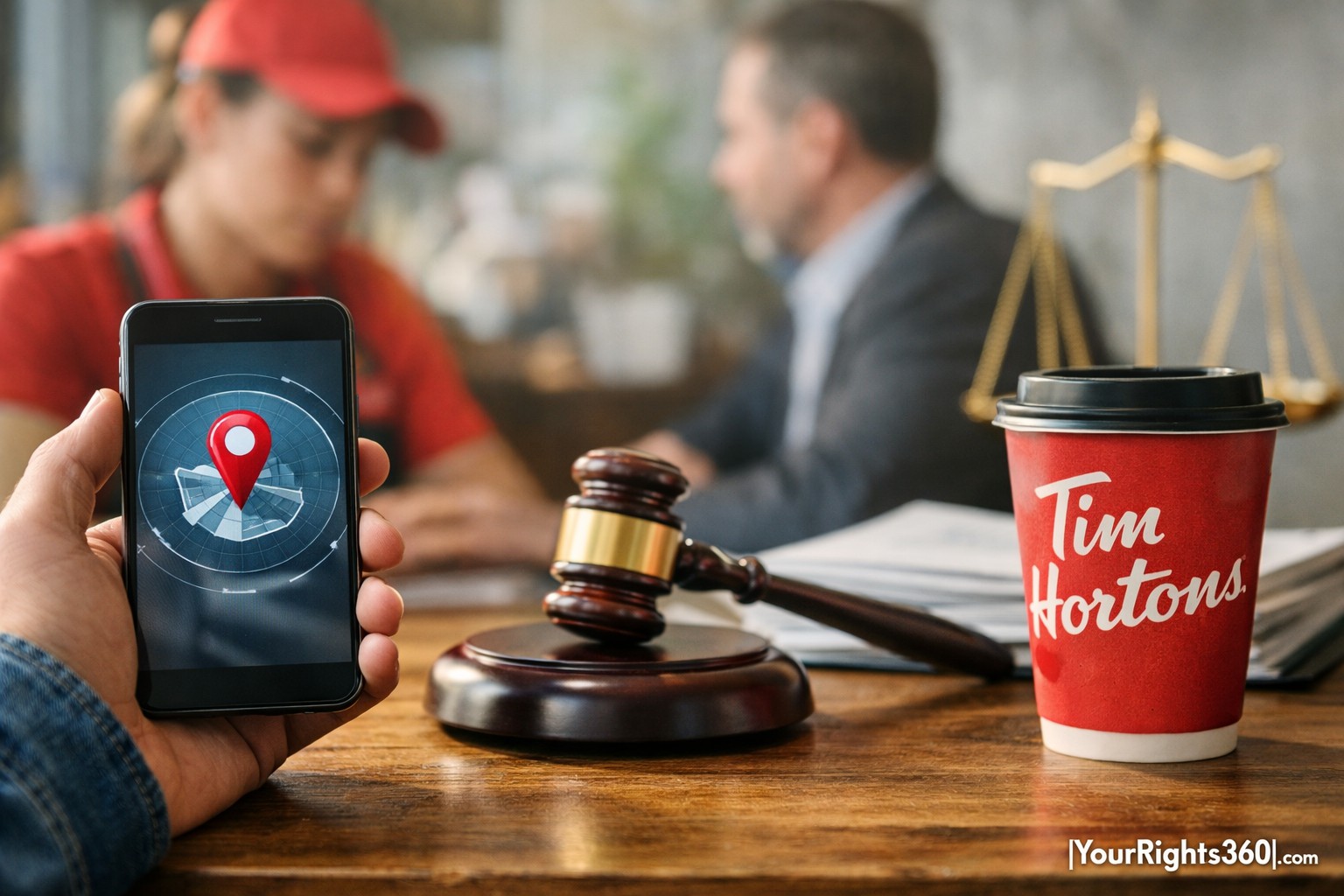
The first major public crack appeared around digital privacy. In 2020, reporting revealed that the Tim Hortons mobile app tracked users far more often than most people realized. This tracking did not pause when the app closed. It ran quietly in the background.
Many users assumed location access only helped locate nearby stores. That assumption did not hold up. Some phones recorded location checks dozens, even hundreds, of times per day.
Canadian privacy law sets clear limits. Consent must be meaningful. Data collection must match a clear purpose. Collection must stay narrow. The lawsuit argued those lines were crossed.
Office of the Privacy Commissioner of Canada report on Tim Hortons app privacy findings. Their conclusion was blunt. The tracking went beyond what users reasonably expected.
No fines followed. That part confused some people. The real weight came from confirmation. Once facts are established by regulators, courts treat them as solid ground.
Why this turned into a class action instead of complaints
Courts look for shared harm. One frustrated user does not move a case forward. Millions affected in the same way often do.
The privacy lawsuit met that standard easily. The same app behaved the same way for everyone. The same consent screens appeared. The same data practices applied across the user base.
That common setup allowed lawyers to argue collective impact. Individual harm might have felt minor. The legal principle did not.
Privacy class actions often work this way. They aim less at payouts and more at limits. They draw lines around what companies can and cannot quietly collect.
The same legal logic later appeared in workplace and franchise disputes. When rules come from the top and apply everywhere, shared issues follow.
Workplace complaints that followed a similar path
Separate cases focused on employees rather than app users. These claims varied by province and position, but they shared themes.
Workers raised concerns about break times. About pay calculations. About schedules that left little room to say no. Availability expectations came up often.
These lawsuits did not claim every store acted improperly. They questioned whether company-wide systems made problems repeatable.
Franchise employment law complicates things. Workers answer to franchise owners. Policies often come from corporate offices. Courts spend time sorting out who controls what.
Some cases moved forward. Others narrowed or ended early. That filtering process is normal. Class actions rarely move in a straight line.
Franchise owners had their own disputes
Not all legal action came from customers or workers. Some came from the people who owned the stores.
Franchise owners raised concerns about rising costs and limited input. Supply pricing. Mandatory renovations. Advertising requirements. Control without balance was a common theme.
These cases focused less on consumer harm and more on fairness inside the franchise relationship. Owners operate independently but depend heavily on brand decisions.
Courts examined disclosure documents and contracts closely. Power balance matters in franchise law. When many owners raise the same concern, group action becomes possible.
Still, not every dispute reaches class action status. Only those with strong overlap tend to move forward.
Costco Canada Class Action Lawsuit Over Membership Charges
How judges approached the cases
Most filings landed in Ontario or Quebec, where national class actions often begin. Courts first reviewed certification requests.
Certification answers one question only. Does this case belong together.
Judges looked at whether claims shared facts. Whether group treatment made sense. Whether justice worked better collectively than individually.
Some claims passed this test. Others failed. That split reflects caution, not weakness.
Privacy cases drew closer attention as digital tracking became a broader concern. Employment and franchise cases required deeper factual digging.
What the company said and what mattered more
Tim Hortons responded publicly to privacy findings. The company said the tracking stopped. Controls were reviewed. Consent language changed.
Regulators pushed for corrections instead of punishment. The goal was prevention.
In employment and franchise disputes, the company denied wrongdoing while defending its systems. That response is standard. Legal admissions rarely happen even when practices shift.
Courts and regulators focus less on statements and more on action. Promises matter only if they stick.
How customers reacted in real life
Most customers felt startled rather than furious. A coffee app knowing nightly routines crossed an unspoken line. Even users comfortable with tracking felt surprised by the scale.
After coverage spread, many users deleted the app. Others tightened phone permissions. The caution spread beyond one brand.
Trust erosion rarely leads to dramatic exits. It leads to quieter behavior changes. People still bought coffee. They paused before tapping “allow.”
That shift explains why privacy cases matter even without compensation.
Several app users described noticing their phone location icon turning on even when they were not ordering coffee or opening the app. At first, it felt easy to ignore. After repeated alerts, some users checked their app permissions and realized how often background tracking occurred. That moment – noticing before reading the news — is what many people later connected to this lawsuit.
What workers experienced on the ground
Employees reacted in mixed ways. Some felt relieved their concerns had a name. Others worried about stability.
Legal protections exist, but fear does not vanish instantly.
Even when cases end without major rulings, internal changes often follow. Scheduling tools adjust. Training updates roll out. Policies grow clearer.
Those changes usually matter more than settlements.
Expectations that often miss the mark
Many people search for class actions hoping for money. That rarely matches reality.
Privacy settlements tend to be small or symbolic. Credits. Minor payments. Sometimes nothing.
The more lasting outcomes look different:
- clearer policies
- public accountability
- legal precedent
- tighter data disclosures
Knowing this prevents frustration later.
Figuring out whether you are part of it
People who used the Tim Hortons app during the time named in privacy cases may fall within class definitions. Employment claims depend on role, location, and dates.
Helpful steps stay simple:
- read official court notices
- follow law firm updates tied to the case
- avoid sites asking for fees
- keep basic records if participation opens
Real class actions do not charge entry.
A pattern bigger than one brand
Tim Hortons is not an outlier. Retailers, food chains, and delivery apps have faced similar claims. Convenience often hides complexity.
Workplace and franchise disputes follow similar pressure points. Growth strains systems. Strain exposes weak spots.
The takeaway is not suspicion. It is awareness. Understanding how scale, data, and control interact helps people navigate modern brands.
Tim Hortons is not an outlier. Other major Canadian brands have faced class actions over consumer harm, including large-scale pricing disputes such as the Class Action Lawsuit Bread Price Fixing in Canada 2026, which raised similar questions about accountability and public trust.
Why this still carries weight
Even when cases quiet down, the ripple continues. Privacy rules tighten. App design shifts. Oversight grows sharper.
Customers learn to question permissions. Workers gain language for concerns. Franchise owners find strength in shared action.
Class actions rarely feel loud day to day. Their influence shows up slowly, in boundaries that did not exist before.
That is why the tim hortons class action lawsuit still matters, even when headlines move on.
Common questions people ask about the Tim Hortons class action lawsuit
Who can be part of the Tim Hortons class action lawsuit
People who used the Tim Hortons mobile app during the period mentioned in the privacy lawsuits may fall within the class definition. Eligibility depends on location, time of use, and the specific legal claim. Employment-related cases depend on job role, store location, and work period.
What is the lawsuit mainly about
The most well-known case focuses on mobile app location tracking that continued in the background without clear user understanding. Other cases involve workplace practices and franchise disputes. Each lawsuit addresses different legal issues under Canadian law.
Do users need to hire a lawyer to be included
Class actions are handled by appointed law firms. Individual users do not need to hire separate lawyers to be included. Participation usually happens automatically if a person meets the class definition, unless they choose to opt out.
Will people receive money from this lawsuit
Privacy-related class actions often result in modest compensation or non-cash outcomes. Some cases lead to small payments, credits, or no direct payout at all. The main outcomes usually involve policy changes, legal accountability, and court-approved corrections.
How can someone check if they are affected
Official court notices and law firm updates provide the most reliable information. These notices explain who qualifies, what steps are available, and whether any action is required. Avoid third-party websites that promise fast payouts or request fees.
What changed after the lawsuit became public
The company stated that the location tracking practice stopped and consent controls were updated. Regulators required changes rather than fines. Many users also adjusted app permissions or removed the app after learning about the issue.