


Case update, October 30, 2026: Walter Loughney’s lawsuit against American Airlines remains an active federal civil case in the latest docket we could verify. His original complaint was dismissed on a pleading issue in May, but he filed an amended complaint on May 12. American Airlines answered on May 28. No liability finding or damages award appears in the reviewed docket.
An American Airlines passenger says he suffered serious head and brain injuries after a fellow traveler attacked him during a flight from Palm Beach, Florida, to Charlotte, North Carolina. Walter Loughney accuses the airline of failing to respond to warning signs and requests for help before the alleged assault. His negligence lawsuit, filed in a federal court in Florida on May 5, 2026, puts a specific question before the court: what should a crew do when a passenger reports feeling unsafe beside someone acting unpredictably?
What happened aboard Flight 2485?
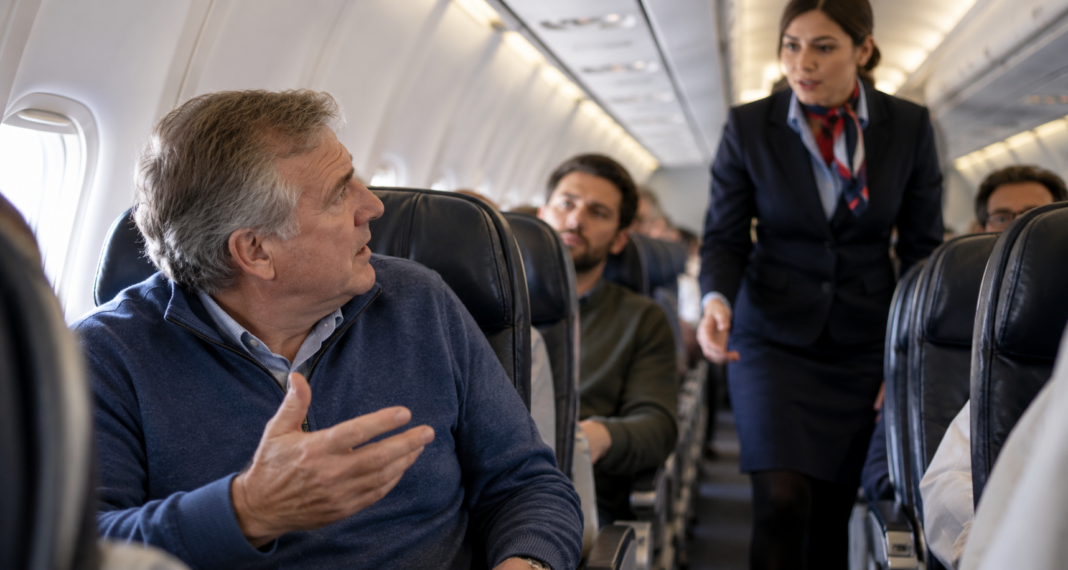
Loughney, who was reported to be 82 when the case became public, alleges that Allisen Elizabeth Werner acted erratically after boarding the May 16, 2024 flight. According to reports describing his complaint, she sang and shouted, and he asked employees to move him to another seat. He says crew members told him that no other seats were available.
Loughney alleges that Werner later punched him repeatedly, causing severe injuries to his head and brain. He also claims that a nearby flight attendant did not intervene. These statements are allegations in civil litigation, not court findings. The information reviewed does not establish precisely what each crew member saw, what alternative seating was available, or whether a particular intervention would have prevented the assault.
Case at a glance
- Flight: American Airlines 2485, Palm Beach to Charlotte
- Incident date: May 16, 2024
- Lawsuit filed: May 5, 2026
- Court: U.S. District Court, Southern District of Florida
- Case: Loughney v. American Airlines, Inc., No. 9:26-cv-80516
- Claim described: Negligence over an alleged passenger-on-passenger assault
How the lawsuit moved through court
A May 6 order dismissed the original complaint without prejudice because its allegations about citizenship did not adequately establish federal diversity jurisdiction. That was a procedural defect, not a decision that the alleged assault did or did not occur. Loughney filed an amended complaint on May 12, before the court’s May 19 deadline.
American Airlines filed an answer and affirmative defenses on May 28. On June 12, the court set a jury trial for June 14, 2027, together with deadlines for discovery, mediation and motions. A scheduled trial is not a guarantee the case will reach a jury. Cases may resolve, change course or be dismissed before trial. The public docket history for Loughney v. American Airlines lists these filings; its displayed retrieval date is June 12, 2026, so later changes may not be reflected there.
What the passenger must prove
A negligence claim does not succeed simply because someone was injured on an aircraft. Under the governing law and the facts that are established, the claimant generally has to show an applicable duty of care, a breach of that duty, a causal connection and legally compensable harm. The specific standard, available defenses and scope of damages depend on the claims and law the court applies.
Foreseeability is a central dispute in many cases involving an attack by another person. Evidence that a crew member knew of a meaningful risk, received a clear warning or had a reasonable opportunity to respond could matter. Equally important is what staff could realistically do under the flight conditions and safety procedures. Conduct that seems troubling in hindsight does not automatically prove an airline had advance notice of a likely assault.
Questions the evidence may answer
- What did the passenger tell crew members, and at what time?
- Were empty or otherwise usable seats available, and what did the crew know?
- Did staff observe conduct that presented a specific risk of physical harm?
- How quickly did the alleged attack unfold, and what response was feasible?
- What medical evidence connects the claimed injuries to the incident?
These questions describe potential factual disputes, not conclusions about how American Airlines behaved.
Can an airline be responsible for another passenger’s assault?
Potentially, but responsibility is not automatic. A person who commits an assault can be directly responsible for their own conduct. A separate claim against a carrier typically examines whether the airline itself failed to take legally required, reasonable precautions or respond appropriately to a known risk. Claims involving an international itinerary can raise different legal questions, including treaty rules, from claims involving purely domestic travel. Flight 2485 was described as a domestic U.S. flight, and this article does not assume an international treaty governs Loughney’s claim.
Air carriers also operate within federal aviation safety rules. Federal law prohibits assaulting or intimidating crew members in ways that interfere with their duties, but that rule alone does not decide whether an airline owes damages to a passenger assaulted by another traveler. The legal and factual issues must be examined separately.
What injured airline passengers can document
If an assault occurs during a U.S. flight, immediate safety and medical care come first. Once safe, a passenger or companion can preserve details that may otherwise disappear.
Useful evidence checklist
- Keep boarding passes, the flight number, seat assignment and booking records.
- Write down when concerns were reported, what was said and who responded.
- Request medical evaluation and retain treatment notes, bills and follow-up records.
- Preserve relevant photographs, messages and contact details for willing witnesses.
- Report the incident to the airline and, where appropriate, law enforcement. Keep reference numbers and copies.
A written complaint can help create a record, although it does not replace emergency assistance, a police report or a civil claim. The U.S. Department of Transportation provides air travel complaint guidance. DOT complaint handling and a private damages lawsuit are different processes.
What happens next in this case?
The June scheduling order sets discovery and motion deadlines, and a June 2027 trial date. Those are planned milestones, not an outcome. Readers should distinguish the passenger’s accusations from the airline’s response and any later judicial findings. A court docket, rather than an early headline about a dismissed first complaint, is the best starting point for checking procedural progress.
Any passenger considering legal action after an in-flight assault should promptly check the law that applies to the itinerary, the possible defendants and the relevant filing deadline. Those questions can change with the route, the circumstances and the jurisdiction.