
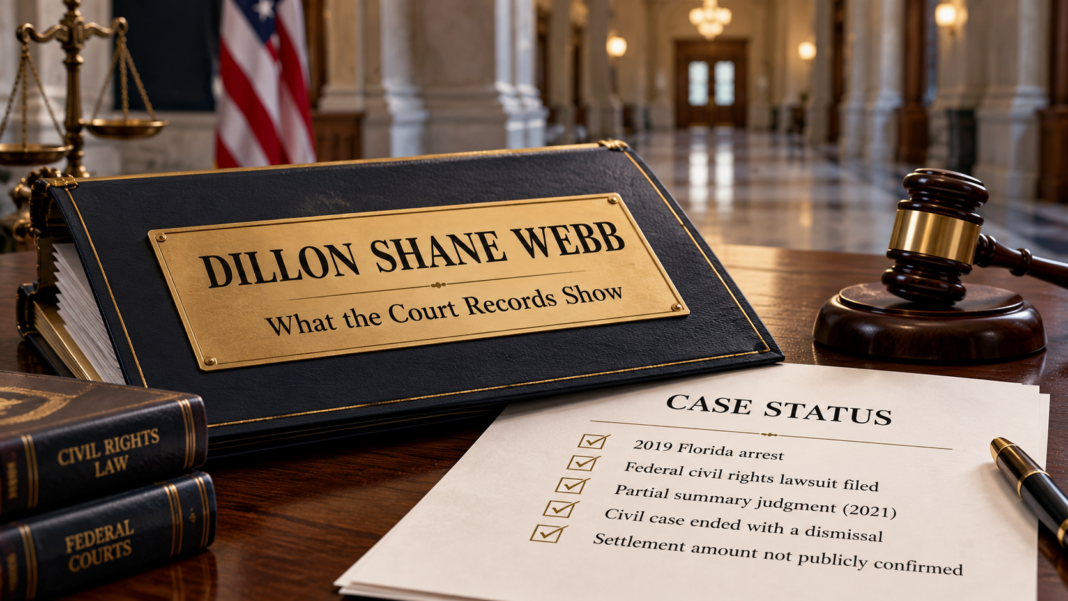


Dillon Shane Webb’s federal civil rights case ended in 2021, but no verified public settlement amount has been established. The Florida man sued after a 2019 arrest tied to a vulgar sticker on his pickup truck. A federal judge later rejected most of his claims but allowed a dispute about the vehicle’s search and impoundment to continue. The parties subsequently ended the case without a public damages verdict. That sequence matters because “case resolved,” “settlement confirmed,” and “Webb received a particular amount” are not interchangeable claims.
Readers looking for a payout figure should treat numbers on unsourced websites with caution. The available September 23, 2021 federal court order in Webb v. English explains the claims and the issues left for further proceedings, not a payment award. Contemporary reporting also establishes the earlier criminal charges were dropped. Those are distinct stages of two different legal proceedings.
CASE RECORD AT A GLANCE
Webb v. English, No. 3:19-cv-00975
Middle District of Florida
Ended after 2021 litigation
No independently verified figure
What Happened to Webb’s Lawsuit?
The underlying incident took place on May 5, 2019, in Columbia County, Florida. Webb drove a Chevrolet pickup with a rear-window sticker bearing the sexually explicit phrase “I EAT ASS.” Deputy Travis English stopped the vehicle, and officers viewed the wording as potentially violating Florida’s rules on obscene material. According to contemporaneous reporting based on the arrest report, the deputy initially issued a notice to appear and asked Webb to alter the lettering. Webb refused, citing free speech. Officers arrested him on charges involving obscene material and resisting an officer without violence.
Prosecutors dropped the criminal charges days later. The prosecutor’s assessment recognized that Webb had a viable First Amendment defense in the circumstances. That decision ended the prosecution; it did not automatically prove the arresting officers were financially liable in a separate civil lawsuit. See News4JAX’s May 9, 2019 report for the contemporaneous dismissal announcement and details from the filing.
Webb then pursued a federal civil rights case against individuals connected with the Columbia County Sheriff’s Office, including Deputy English. The lawsuit questioned aspects of the traffic stop, arrest, searches and official conduct. Each legal theory required its own analysis. A claim involving free expression did not necessarily rise or fall with a claim involving a vehicle search.
The September 2021 Court Decision
On September 23, 2021, U.S. District Judge Marcia Morales Howard issued a substantial summary judgment order. It gave the defendants judgment on numerous claims, including claims relating to First Amendment retaliation, under qualified immunity principles. The judge did not enter a finding that every officer action was constitutionally proper. Qualified immunity can protect an officer from civil liability where the asserted right was not clearly established under the relevant law when the incident occurred.
One important issue survived the motions: a dispute involving the decision to impound and search Webb’s vehicle. The opinion found material factual issues affecting whether the vehicle’s inventory search could be justified on the record presented. That meant a claim against English could proceed; it was not a final judgment for Webb on that claim.
The distinction is easy to miss in online summaries. A court allowing one claim to continue means only that it was not disposed of at that procedural stage. Neither side should be credited with a monetary victory until the relevant record supports it.
Was There a Settlement Payment?
Available accounts of the federal docket describe the lawsuit ending through an agreed dismissal in November 2021. A joint dismissal with prejudice closes the claims covered and generally prevents the same claims from being refiled. It does not, on its own, establish what either side paid or received. Parties may agree to private terms, or may simply choose not to continue litigation. A dismissal document that does not state money cannot verify a dollar figure.
Some web articles call the outcome a settlement. That description may reflect the parties’ agreement to end the case, but the precise financial terms remain unverified in the public sources reviewed for this article. This is why reports that Webb received a six-figure or seven-figure award should not be repeated as fact without an actual settlement document, court filing, agency disclosure, or reliable attributed reporting.
Expenses linked to the original arrest also do not reveal the settlement value. Bond amounts, towing costs, lost earnings or legal expenses might form part of a person’s claimed losses; they are not the same thing as damages paid after a civil case.
Why the First Amendment Did Not Settle Everything
The two proceedings applied different legal questions. Prosecutors had to consider whether they could prove criminal charges under the law and evidence. They ultimately declined to prosecute. In federal civil court, Webb had to show that specific defendants violated federal rights and overcome defenses such as qualified immunity. The fact that prosecutors abandoned the criminal case did not eliminate those civil defenses.
It is also inaccurate to say the federal judge ruled that the sticker definitely was obscene. The court’s analysis considered whether an officer could reasonably view the material as potentially unlawful for the limited purpose of evaluating immunity. A finding about arguable legal grounds for an officer’s actions is not the same as a definitive First Amendment classification of the speech.
Equally important, the lawsuit’s remaining vehicle-search issue turned on Fourth Amendment principles, including the circumstances of impoundment and inventory searches. That claim was not simply a second version of the dispute about the sticker’s wording.
A Timeline of the Verified Events
May 5, 2019: Webb was arrested after a traffic stop involving the sticker on his truck.
May 9, 2019: Florida prosecutors dropped the criminal charges, citing the strength of a First Amendment defense.
2019: Webb brought his civil rights lawsuit in the U.S. District Court for the Middle District of Florida.
September 23, 2021: The federal judge granted summary judgment in part and denied it in part.
November 2021: Available case accounts describe the civil action ending through an agreed dismissal. No verified public dollar amount accompanies the resolution.
These dates help prevent an especially misleading claim: that there is a new 2026 settlement open for consumers. The lawsuit concerns a 2019 arrest and a single plaintiff. Nothing in the sources reviewed identifies a class action administrator, general claims portal, or payment deadline for the public.
Can Anyone File a Claim?
No public settlement claim program has been identified for this case. Webb sued over events specific to him, not as a representative of a class of people allegedly harmed by the same defendant. An ordinary reader has no basis to file for money simply because they read about the case.
If an unfamiliar website advertises a Dillon Shane Webb compensation form, check its identity and the underlying court order before providing contact details, bank information, or a fee. A legitimate court settlement with a public claims process ordinarily identifies an administrator, eligible class, controlling documents, and deadlines. The absence of those details is a reason to verify the advertisement carefully.
Other legal disputes genuinely may create settlement claims for eligible consumers. Readers can compare the evidence and deadlines in our MHCC class action settlement guide, which concerns a separate case and should not be confused with Webb’s lawsuit.
Questions About the Case Outcome
A reliable public settlement amount has not been confirmed in the court records and credible reporting reviewed.
A mixed September 2021 decision dismissed most claims but allowed a vehicle-search claim to continue.
Prosecutors dropped the charges in May 2019, separately from the civil lawsuit.
Webb brought an individual civil rights lawsuit. A public class action compensation process has not been identified.
It permanently closes the covered claims, but does not itself establish that money changed hands.
The Reliable Answer on the Settlement
Dillon Shane Webb’s case is important because it involved the boundary between provocative expression, the limits of qualified immunity and the legality of vehicle searches. The strongest public evidence supports the arrest, dropped charges, mixed summary judgment decision and the subsequent end of the civil lawsuit. It does not support a precise settlement payment amount.
Anyone evaluating a new claim about this case should start with the actual September 2021 court opinion, then seek the final dismissal document before accepting an account of the financial outcome. This article provides general legal information, not advice about an individual’s rights.