
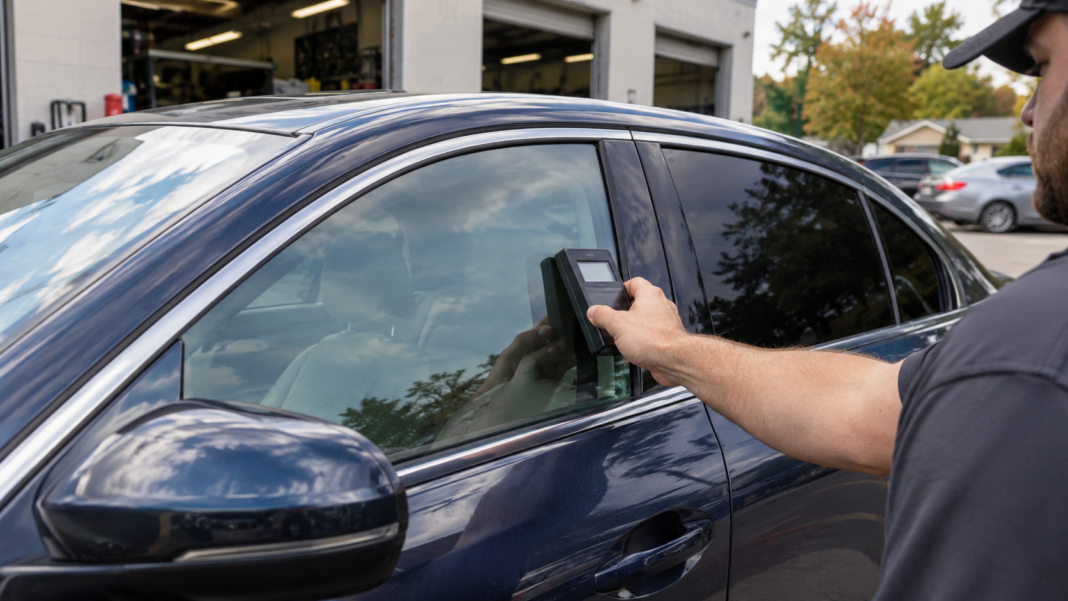


Virginia allows window tint, but the legal limit depends on which window is covered and what type of vehicle you drive. Most passenger cars must allow at least 50% of light through the front side windows and 35% through the rear side windows and back window. Pickup trucks and qualifying multipurpose passenger vehicles have a different rule for glass behind the driver.
A tint percentage describes visible light transmission (VLT), not how much darkness a film adds. Lower VLT means a darker finished window. Virginia measures the light passing through the complete glass-and-film combination, so a roll marked 50% does not necessarily produce a finished window that meets the 50% legal threshold.
Virginia tint limits at a glance
Front side windows: 50% VLT or higher. Rear side and rear glass on ordinary passenger cars: 35% VLT or higher. Windshield: ordinary dark tint is restricted, but qualifying clear film is allowed under the 2026 law. Special exemptions apply.
Legal Limits for Each Window
Virginia Code § 46.2-1052 sets the standard window tint rules. Its requirements assume the vehicle has an outside mirror on each side that gives the driver a view of the road at least 200 feet behind the vehicle. A different rule or exemption may apply if that condition is not met.
| Window or feature | Ordinary passenger car | Pickup or qualifying multipurpose vehicle |
|---|---|---|
| Front side windows | At least 50% VLT | At least 50% VLT |
| Rear side windows | At least 35% VLT | Darker than 35% may be permitted |
| Rear window | At least 35% VLT | Darker than 35% may be permitted |
| Windshield | Ordinary dark film restricted; qualifying clear film allowed | Same general rule |
| Film reflectance | No more than 20% | No more than 20% |
Virginia also prohibits tint film that produces a holographic or prism effect. Reflective film cannot exceed 20% light reflectance. These requirements apply even if the visible light percentage otherwise appears legal. Read the current Virginia window tint statute before purchasing film or relying on a general tint chart.
Windshield Tint Changed in 2026
Ordinary darkening film cannot cover the main viewing area of a windshield. Virginia generally limits sun-shading film to the upper area associated with the manufacturer’s original sunshield. A 2026 change expressly permits clear windshield film if it is maintained in compliance with the federal glazing standard at 49 C.F.R. § 571.205.
Clear does not mean every nearly transparent product automatically qualifies. Ask the installer for the product’s documented compliance with the glazing standard and check the finished installation. A legal medical authorization can permit additional shading under its separate limits.
Older state reference sheets may still say that all windshield film is prohibited. Check their publication dates against the current statute, especially when a shop relies on a chart printed before the 2026 amendment.
Why SUVs and Pickup Trucks Differ
Virginia lets a pickup truck or qualifying multipurpose passenger vehicle use film darker than 35% on the rear side windows and rear window. That exception does not extend to the front side windows. Drivers still need the required outside mirrors and must comply with the rules against excess reflectance and prohibited optical effects.
A vehicle marketed as an SUV is not automatically exempt just because its label says SUV. Virginia uses a statutory definition that considers the vehicle’s design, chassis, passenger capacity and features. Confirm the vehicle’s classification if the tint shop plans to apply very dark film behind the driver’s seat.
Factory privacy glass also matters. A rear window that looks dark from the factory is not the same as an ordinary sedan window with aftermarket film. Have the complete window measured and confirm which statutory vehicle category applies.
Medical Exceptions Require DMV Authorization
Virginia Code § 46.2-1053 permits additional sun shading for a vehicle operated by or regularly used to transport someone with a qualifying medical condition affected by sunlight or bright artificial light. A physician or optometrist must support the medical need, and Virginia DMV must issue written authorization. A prescription or doctor’s note alone does not replace that DMV approval.
Approved medical shading may allow 35% VLT on the front side windows. Medical windshield shading must generally retain at least 70% light transmission, apart from the permitted upper five-inch or AS-1 area, whichever is closer to the top. Authorization is tied to the medical need and ends when the condition no longer exists or the vehicle is sold, whichever comes first.
Drivers seeking an exemption can complete the official Virginia DMV Sun-Shading Medical Authorization Application (MED 20). Its medical certification section and vehicle details should be completed as required. Keep the resulting written authorization with the vehicle when it is operated on a public road. The publicly available MED 20 form carries an older revision date, so the current code should control any apparent conflict about ordinary clear windshield film.
How Officers Measure Tint Compliance
Virginia law requires law enforcement to use approved equipment to measure window light transmission. It provides a seven-percentage-point negative measurement tolerance. That margin is an enforcement rule, not permission to order film that is seven points darker than the legal limit.
A professional tint meter checks the finished glass, not merely the stated rating on the film package. Ask for the meter reading after installation, and record it for your files. Remember that the reading can differ from the nominal VLT printed on a product label.
Tickets, Traffic Stops and Penalties
Driving with tint below the statutory limit, film with excessive reflectance, or a prohibited holographic or prism effect is a traffic infraction. Section 46.2-1052 says DMV does not assign demerit points for these tint violations. Installers who apply prohibited film in Virginia can face separate misdemeanor penalties.
Virginia also prohibits officers from stopping a vehicle solely for a violation of this particular tint section. This does not mean unlawful tint is permitted or cannot be cited when an officer has another lawful reason for a stop. Evidence obtained from a stop that violates the section’s restriction faces the exclusion rule stated in the statute.
If you receive a summons, the court may dismiss it at its discretion when proof of compliance is provided by the court date. Keep the citation, dated photographs, the installer receipt and any reliable tint-meter results. Correcting the tint does not guarantee dismissal, so follow the instructions on the actual summons.
Check Before Paying a Tint Installer
Before installation, tell the shop the vehicle’s exact make, model, body type and intended use. Ask whether the quoted VLT is a film specification or the expected finished-window reading. Confirm the windshield product separately because its requirements differ from side and rear glass.
- Ask the installer to identify the legal limit for each individual window and your vehicle classification.
- Request a measurement of the finished glass and an invoice that identifies the installed film.
- Check reflectance and any special medical authorization instead of focusing on darkness alone.
- Keep a copy of any DMV authorization and check another state’s law before relying on Virginia limits during a move or trip.
Different states set different traffic equipment rules. Our traffic law coverage discusses other state-specific road requirements, but you should consult the destination state’s current tint statute before assuming that a Virginia-compliant installation is legal elsewhere.