
Janice Griffith’s lawsuit was a personal injury case against Dan Bilzerian and a Hustler-related company after a rooftop stunt went wrong during a photo shoot in Los Angeles. On April 23, 2014, Bilzerian attempted to throw Griffith from a rooftop into a swimming pool as part of the shoot. She fell short of the intended landing, struck the pool area, and suffered a serious foot injury that contemporary reports described as a broken foot. Griffith later claimed that the stunt had been presented as safe and that the people involved should be held responsible for her injury.
Griffith filed her lawsuit in Los Angeles Superior Court in December 2014 and sought damages linked to her injury and lost work. Bilzerian denied liability and argued that she had agreed to the stunt and accepted its risks. The dispute therefore centered on negligence, stunt safety, consent, assumption of risk, and responsibility for the failed landing. No public trial verdict ultimately decided those issues. The case ended without a reported court judgment, and no reliable public record confirms an exact settlement amount paid to Griffith.
Janice Griffith Lawsuit Case Overview
The case is generally identified as Janice Griffith v. LFP Internet Group LLC et al., Los Angeles Superior Court Case No. BC566899. Contemporary reporting confirms that Griffith sued Dan Bilzerian and a Hustler-related entity after the rooftop incident. Later docket summaries also show that the dispute became more complex as the defendants raised claims over who should bear responsibility if Griffith recovered damages.
| Case detail | Reported information |
|---|---|
| Incident date | April 23, 2014 |
| Plaintiff | Janice Griffith |
| Main defendants | Dan Bilzerian and Hustler-related entity |
| Court | Superior Court of California, County of Los Angeles |
| Case number | BC566899 |
| Case type | Personal injury |
| Reported injury | Foot injury, widely reported as a broken foot |
| Lawsuit filed | December 16, 2014 |
| Trial verdict | None located |
| Public settlement amount | None verified |
A useful distinction matters here. Griffith’s pre-suit demand and her later lawsuit are not the same thing. Reports and Bilzerian’s lawyer’s own May 2014 letter refer to an $85,000 demand connected to Griffith’s injury. Her December lawsuit, however, sought unspecified damages and lost wages rather than a publicly stated $85,000 judgment request.
How Janice Griffith Was Injured During the Rooftop Stunt
Griffith was 18 when the incident took place during a Hustler photo shoot at Dan Bilzerian’s Los Angeles home. Courthouse News Service reported that she alleged Bilzerian threw her from the rooftop toward a swimming pool as part of the shoot. TMZ later reported that the photo shoot was designed to show Bilzerian’s luxury lifestyle, and Griffith claimed that the rooftop stunt was proposed by Bilzerian and Hustler. She also alleged that she was told the stunt would be safe. The attempt did not go as planned. Griffith fell short of the intended landing area, struck the edge of the pool, and suffered a foot injury that later affected her ability to work.
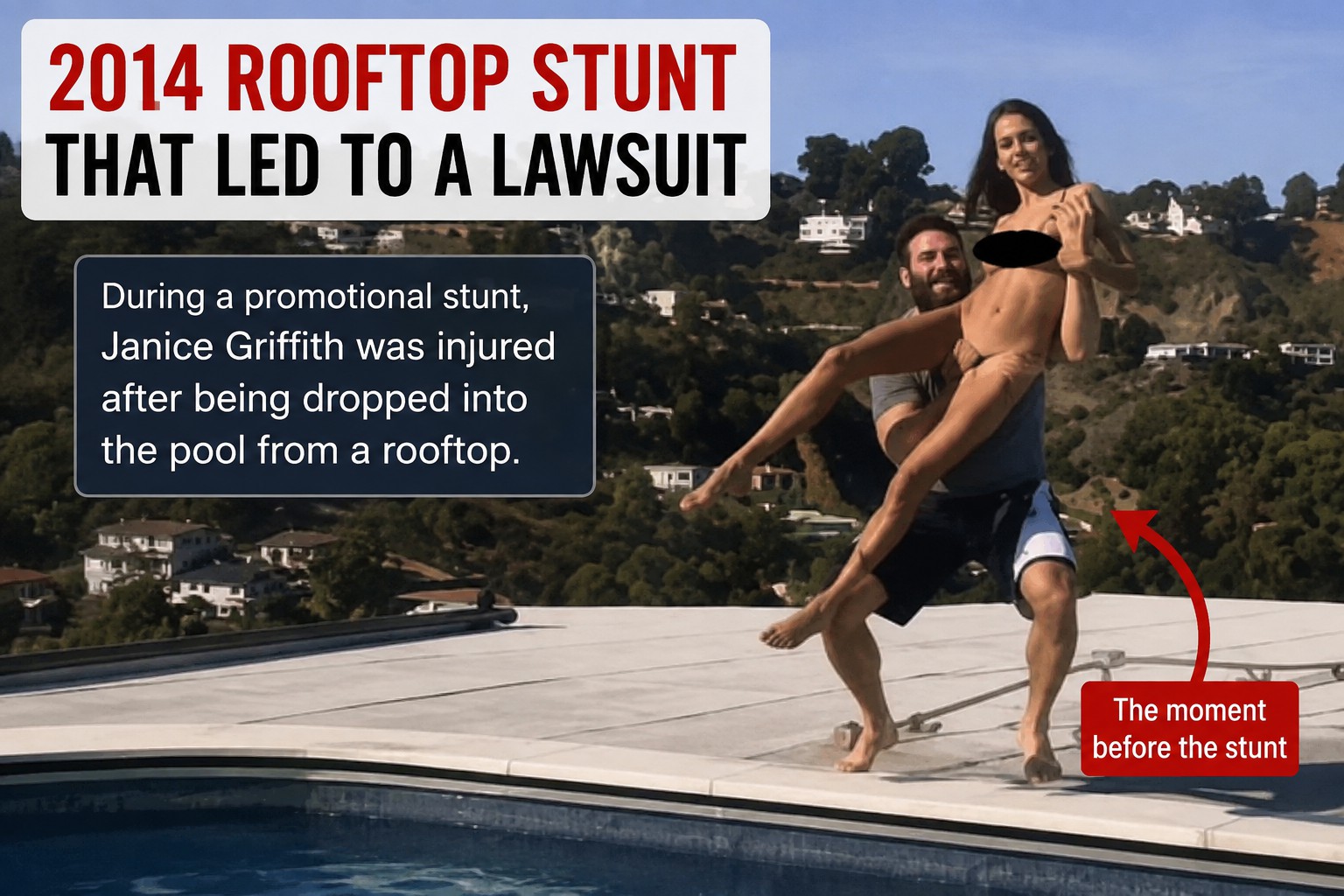
The incident was captured on video, which made it an important part of the dispute. Griffith used the footage and her injury to support her claim that the stunt was unsafe, while Bilzerian disputed responsibility and challenged how the failed throw occurred. The video confirmed that the accident happened, but it did not automatically prove negligence. Griffith still had to show that the defendants had a duty to keep the stunt reasonably safe, failed in that duty, and caused her injury. This is why the footage mattered to both sides rather than proving the case on its own.
What Did Janice Griffith Allege in Her Lawsuit?
Griffith filed the civil case on December 16, 2014. Reports on the complaint said she alleged that the defendants proposed the stunt, assured her that it was safe, and should have recognized that her background did not qualify her to perform such an activity safely. She sought compensation tied to her injury and lost wages.
Her legal theory was therefore broader than the simple fact that Bilzerian physically threw her. Production control also mattered. If a company plans a dangerous scene, directs participants, selects who performs it, or gives safety assurances, those facts can become relevant to a negligence dispute. That does not establish that Hustler was legally responsible in this case, but it explains why a production-related defendant appeared beside Bilzerian in the complaint.
The case also should not be described as a criminal prosecution. Griffith sought civil damages for an alleged personal injury. Public sources reviewed for this article do not show criminal charges against Bilzerian based on this rooftop accident. The lawsuit concerned financial responsibility for injury, not criminal punishment.
Bilzerian’s Defense Centered on Consent and Accepted Risk
Months before Griffith filed the lawsuit, attorney Tom Goldstein sent a May 12, 2014 letter on Dan Bilzerian’s behalf. He argued that Griffith had agreed to the rooftop stunt, practiced before the attempt, and accepted the risks involved. Goldstein also claimed that video showed Griffith grab Bilzerian’s shirt during the throw, which may have affected the landing. These were defense arguments, not findings made by a judge or jury.
Goldstein also disputed Griffith’s claimed losses and referred to an $85,000 demand made before the lawsuit. His main position was that Griffith had accepted the stunt and may have contributed to the accident herself. Those questions were never decided through a public trial verdict.
Could Janice Griffith Agree to the Stunt and Still Sue?
Agreeing to the rooftop stunt did not automatically prevent Griffith from bringing an injury claim. California’s assumption-of-risk rules consider the type of activity, the danger she accepted, and whether another party created risks beyond what she reasonably agreed to face. Bilzerian’s side relied on Griffith’s consent, the rehearsal, and the claim that she grabbed his shirt during the throw. Griffith’s position focused on how the stunt was planned, the safety assurances she said she received, and whether those involved took reasonable steps to prevent injury.
California’s comparative-fault rules could also have divided responsibility between the parties. Griffith’s own actions might have reduced any damages without necessarily ending her claim. A trial could have examined the video, testimony, contracts, and other evidence to decide these issues, but the case ended without a public verdict. No court ultimately determined how much responsibility belonged to Griffith, Bilzerian, or the other parties.
How Hustler and Bilzerian Disputed Liability
The dispute became more complex when the defendants raised claims against each other. Docket records show that LFP filed a cross-complaint in January 2015, and Bilzerian later raised an indemnity claim. These filings were meant to address who might have to pay if Griffith succeeded, rather than admit that either defendant was responsible for her injury.
The cross-claims added another question to the case: whether Bilzerian, the Hustler-related company, or another party should carry some or all of the financial responsibility. Since the lawsuit ended without a public verdict, the court never issued a final ruling that divided liability among them.
How the Janice Griffith Lawsuit Ended
Docket-based reports indicate that the case did not reach a public trial or jury verdict. Griffith reportedly asked to dismiss her complaint with prejudice in December 2015, and the remaining cross-claims were also dismissed around that period. A dismissal with prejudice generally means the same claim cannot simply be filed again.
Settlement-related activity appeared in the case before the dismissal, which suggests that some issues may have been resolved through negotiation. However, public records do not clearly confirm the full terms or an exact payment to Griffith. This means it would be inaccurate to say that Griffith won the case or that Bilzerian was cleared by a court. The lawsuit ended without a public ruling that decided who was legally responsible.
Was the Janice Griffith Settlement Really $85,000?
No reliable public record confirms that Janice Griffith received an $85,000 settlement. That figure came from a pre-lawsuit compensation demand referenced by Bilzerian’s attorney in May 2014. Griffith’s later complaint sought unspecified damages and lost wages, but publicly available records do not show a confirmed final payout. The $85,000 figure should therefore be described as a demand, not a verified settlement amount.
Who Won the Lawsuit Between Janice Griffith and Dan Bilzerian?
There is no verified public trial judgment that allows the case to be described honestly as a courtroom win for Griffith or Bilzerian. Griffith brought a real personal injury lawsuit, Bilzerian disputed responsibility, the litigation continued through 2015, and dismissal followed. No jury verdict established negligence, no public damages award has been identified, and no reliable public settlement amount is available.
Three points help separate fact from speculation:
- Confirmed: Griffith filed a personal injury lawsuit over the April 2014 rooftop incident.
- Confirmed: Bilzerian disputed liability and raised assumption of risk and Griffith’s alleged role in the failed landing.
- Not publicly established: a specific settlement amount, a liability verdict against Bilzerian, or a court ruling declaring Griffith solely responsible.
Calling one side a clear winner would therefore add certainty that the public record does not support.
Could Griffith Agree to the Stunt and Still Sue?
Agreeing to take part in the stunt did not automatically remove Griffith’s right to bring an injury claim. A person can accept certain risks and still argue that another party acted negligently or made the activity more dangerous than expected. Bilzerian’s side pointed to Griffith’s consent, the rehearsal, and the claim that she grabbed his shirt during the throw. Griffith’s side could point to the stunt’s design, safety assurances, her lack of stunt experience, and the role of those who organized the shoot.
California’s assumption-of-risk and comparative-fault rules could have affected how responsibility was divided. A trial could have examined the video, testimony, contracts, and other evidence to decide those issues. However, the case ended without a public verdict, so no court conclusively ruled on how much responsibility belonged to Griffith, Bilzerian, or the other parties.
Final Summary
Janice Griffith’s lawsuit arose from an April 2014 Hustler-related photo shoot in which Dan Bilzerian threw her from a rooftop toward a pool and she suffered a foot injury. Griffith sued Bilzerian and a Hustler-related entity in Los Angeles Superior Court in December 2014, alleging that the dangerous stunt had been proposed and presented as safe. Bilzerian denied responsibility and relied heavily on consent, assumption of risk, and the claim that Griffith grabbed his shirt during the throw.
The case continued through 2015 but produced no public trial verdict. Docket-based reports indicate dismissal after settlement-related activity, yet no reliable public record reviewed here confirms a specific payout or complete settlement terms. That makes the safest conclusion straightforward: Griffith filed a genuine personal injury case, liability remained disputed, the lawsuit ended without a public merits verdict, and an exact settlement amount has not been verified.



Pingback: Adriana Chechik Lawsuit Status and TwitchCon Injury Facts